The Ugly Stepsister
2025
Rated NR
Genre: Horror
Country: Norway
Run-Time: 1h 49min
Director: Emilie Blechfeldt
Cast
Lea Myren……………………………Elvira
Ane Dahl Torp……………………Rebekka
Thea Sofie Loch Næss……Agnes
Flo Fagerli……………………………Alma
Excerpt from Cinderella by Jacob and Wilhelm Grimm
I’m not about to get into the origins of the Cinderella folklore—we have Wikipedia for that—but the Grimms’ version appears to be the first to have the stepsisters use self-mutilation as a means of pleasing their mother and tricking the prince into marrying them. Having read this version, I’ve doubts that the Grimms’ prince is all that much of a catch considering he needed a bird to tell him—twice—that the women he was choosing to marry him were not actually the one he was looking for and that they were just getting the slipper bloody. But hey, I guess the third time’s a charm.
Interestingly enough, in the Grimms’ story, the stepsisters were not considered ugly—they just had the wrong size feet. Apparently, they “were beautiful, with fair faces, but evil and dark hearts.” The ugliness of the stepsisters was actually much better established 175 years prior in Charles Perrault’s Cendrillon ou La petite pantoufle de verre. In this story, “Cinderella, notwithstanding her coarse apparel, was a hundred times more beautiful than her sisters, although they were always dressed very richly.”
Perrault’s story, of course, was the version adapted by Walt Disney—which is a pity, really. I would have liked to seen the stepsisters eventually get their eyes plucked out by birds.
Fortunately, Norwegian filmmaker Emilie Blichfeld seems to lean a little more towards the Grimms’, at least in morbidity. Hers is actually more of an amalgamation of the many existing interpretations of Cinderella, with a subversive twist. This time, we are getting the story from the eldest stepdaughter’s perspective.
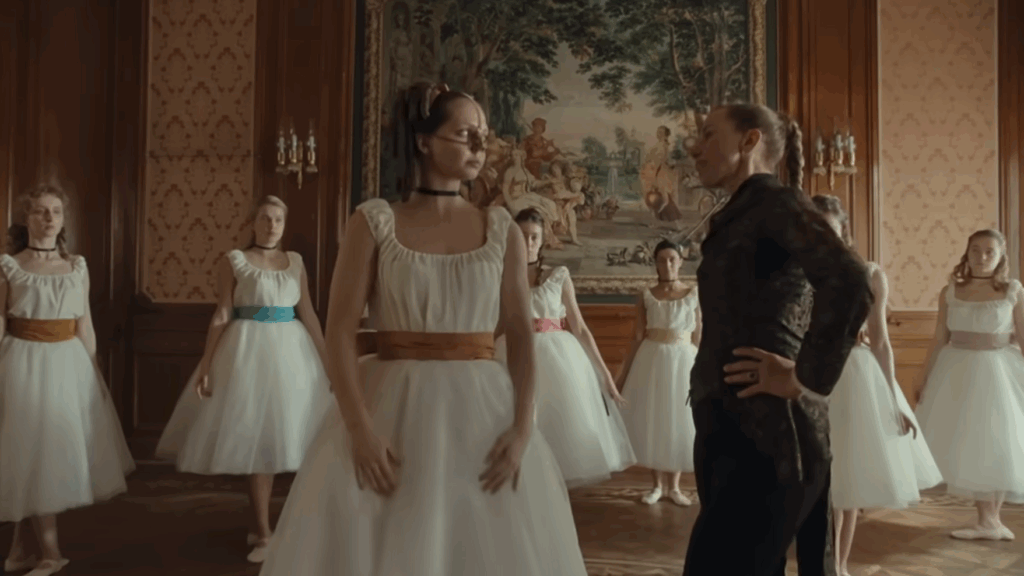
The Ugly Stepsister starts with two families uniting before being quickly torn apart. Widow Rebekka (Ane Dahl Torp) remarries a much older widower she assumed was wealthy, and on their special day the families move into his estate. But he dies suddenly during the wedding feast, and in the days that follow it is revealed that he was penniless.
Fortunately, the prince wants to marry and is inviting all the rich maidens in the land to vie for his attention at an upcoming ball. Seeing a way out of financial ruin, Rebekka looks toward her eldest daughter Elvira (Lea Myren), but also is aware of the potential threat of her beautiful new stepdaughter, Agnes, (Thea Sofie Loch Næss).
The problem is that Elvira is both naïve and ugly—but she has long fantasized about the prince, even reading his poetry, so she has motivation. And Rebekka uses this against the girl as a way of convincing her to start a sequence of painful cosmetic treatments intended to make her beautiful before the ball.
And so begins the body horror. It starts with the removal of braces—simple enough—but quickly escalates to nightmare territory. More than once, I had to look away while watching this movie… which felt good, because it’s been a while.
Lea Myren delivers a powerful performance as Elvira, capturing her transformation from naïve and hopeful to spiteful and ultimately broken. At first, Elvira clings to fairy-tale dreams, her wide-eyed innocence making her easy prey for her mother’s manipulations. As the pressure to become beautiful builds, Myren subtly shifts the character’s tone to show jealousy and resentment bubbling beneath the surface. Of course, we all know the direction this is heading.
Credit is due to Blichfeld for her bold subversion of the Cinderella archetype. Rather than portraying Agnes as a symbol of virtue and innocence, Blichfeld reshapes her into a figure that is mature, intelligent and quietly strategic. (It also doesn’t hurt that actress Thea Sofie Loch Næss has a kind of natural beauty to her as well that very few women could compete against.) This version of Cinderella isn’t driven by kindness or dreams of rescue, but by self-preservation and a fondness for a stable boy that is probably only seen in the pornographic versions.
Speaking of which, how many other Cinderella adaptations show boobs and a penis?
Funny enough, one of Blichfeld’s influences was the family-friendly 1973 Czech film Three Wishes of Cinderella, a film not hard to find online. I gave it a quick view and had to laugh at how the Cinderella in that film had a playful, flirtatious encounter with its prince while he was hunting with friends. To fully appreciate the scope of Blichfeld’s dark humour, it’s worth comparing that lighthearted scene to Elvira’s far more disturbing encounter with her film’s prince while he’s hunting in The Ugly Stepsister. And its worth noting that a whole generation of Norwegian children grew up watching Three Wishes of Cinderella. It was on television every Christmas.
Dark, morbid humour and satire is plentiful in The Ugly Stepsister, as familiar fairy tale tropes get turned on their heads. And its gross-out horrors are well placed and masterfully executed.
The Ugly Stepsister blends dark comedy and body horror to transform a centuries-old archetype into a haunting, tragic exploration of society’s obsession with extreme beauty ideals. With unflinching visual style and transgressive narrative choices, the film carves out a unique voice in contemporary horror. For a debut full-length film, Blichfeld has created a standout film at a time when exploring beauty standards through body horror has become more of a trend.