
Good Boy
2025
Rating: R
Genre: Horror, Thriller
Country: U.S.
Run-Time: 1h 13min
Director: Ben Leonberg
Cast
Indy……………………………himself
Shane Jensen………..Todd
Arielle Friedman……Vera
When watching Good Boy, it’s hard not to recall another IFC film I recently watched: In a Violent Nature. Sure, they’re both IFC releases, but more importantly, both are low-budget films that lean on unusual perspectives as a marketing hook. While In a Violent Nature follows the slasher killer, Good Boy follows a Nova Scotia Duck Tolling Retriever. (Yeah, I looked that up. I’m not a secret dog-breed expert.)
I’d argue one of these films lands better than the other, and it comes down to commitment to the concept.
Yes, both films break perspective at some point, but Good Boy does it sparingly, quickly, and with purpose. Our dog protagonist, Indy, is the focus for about 98% of the movie. (I’d say 99%, but it’s a pretty short film.) That commitment to the premise makes a difference.
Because once you open In a Violent Nature with a group of young people having long conversations around a campfire, cutting back to extended shots trailing behind the killer—like a third-person video game—as he trudges through the woods makes less and less sense. In the end, the only way the film really works is if it fully commits to the killer’s perspective (only shifting it at the end, as it does) or goes for a true one-continuous-shot approach like MadS. Otherwise, the half-commitment to the gimmick gives viewers a reason to question whether returning to the killer’s POV is actually the best way to tell this story.
But I don’t like being negative, since it’s so damn easy. So I’ll point out that In a Violent Nature has some fantastic kill scenes, and if that’s your jam, you might still find it worth watching. I didn’t hate it, but this is the last time I plan to write about it.
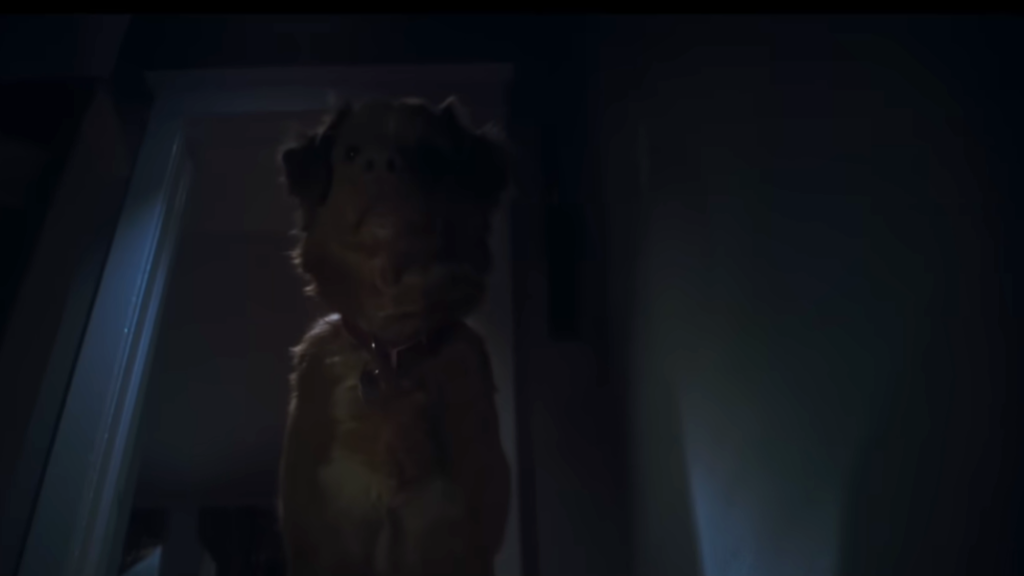
By contrast, I never doubted that telling Good Boy from the dog’s perspective was exactly the right choice for the story Ben Leonberg wanted to tell. That conceit is what makes Good Boy a horror film unlike anything else.
The story is about Indy, a dog whose owner, Todd, has a seizure in the early frames. Todd, it turns out, is very sick—in fact, probably terminal. But Todd’s life, at least at this point, seems closed off from people. His only real connections appear to be with his dog and his sister.
There is a montage of scenes showing Todd with Indy as a puppy and the bond that developed between the two over the years. If you are a pet owner, the scenes probably feel familiar and nostalgic. But then there is the sign that something’s wrong. Indy senses a supernatural presence around Todd, and it only gets worse after Todd moves into his grandfather’s remote country home.
Good Boy is told from Indy’s perspective, so piecing together what the supernatural presence actually is is never fully explained. However, there are enough fragmented mentions of family curses and “that thing that happened to Grandpa” to give viewers a pretty good idea. But honestly, does any of it really matter? Good Boy is an example of horror as metaphor, and it doesn’t take a genius to deduce what kind of presence might linger around a terminally ill man.
Most of us have grown up hearing stories about animals and their peculiar, protective behaviour around dying owners. It wasn’t that long ago that I heard a story about a cat in a nursing home that would always take an interest in patients the day before they died. Leonberg’s film exploits this idea by showing us a shadowy supernatural world that Indy senses and sees, but Todd does not.
To help sell the idea that this film really is from Indy’s perspective, Leonberg intentionally obscures the faces of humans in most scenes, either hiding them in shadow or keeping them out of frame. The film has two dream sequences. Both are Indy’s. (As someone who usually finds dream sequences to be a lazy storytelling trick to add a jump scare, I thought the dream sequences in Good Boy, which explore the dog’s anxieties, were kind of awesome.)
In fact, the movie only breaks perspective a couple of times at the end of its 78-minute runtime to show events from Todd’s point of view while Indy is elsewhere. These scenes are kept short and are necessary for the story. For the most part, Leonberg tells the story as the dog would have perceived it.
And wow, did they ever find an emotive dog. My god. Those shots of Indy looking contemplative with his head out the car window are priceless.
The actual horror in Good Boy is almost aggressively restrained. Long stretches play out in near silence, with Leonberg letting ambient sounds, off-screen movement, and Indy’s reactions do the work instead of jump scares. When something finally does intrude, it’s rarely loud or explicit; it’s more unsettling because it feels wrong. The horror is slow, suffocating, and deeply sad, and while the film may frustrate viewers looking for conventional payoffs, its commitment to dread over spectacle makes the experience feel intimate.
Good Boy works because Leonberg understands exactly what it wants to accomplish and refuses to blink. Its protagonist may be furry, but this is still a story that hits at the heart of the human condition. Indy can neither understand the approaching entity nor spare his loved one from it. What he does understand is that Todd is growing physically weaker and mentally more erratic, and his only choice is to stay loyally by his side and do what he can to help Todd make it to another day. That’s what keeps this pseudo-experimental indie horror about a dog strangely relatable and oddly grounded.