Kill List
2011
Rated: NR
Genre: Crime, Horror
Country: U.K.
Run-Time: 1h 35min
Director: Ben Wheatley
Cast
Neil Maskell……………………..Jay
Michael Smiley……………….Gal
MyAnna Buring……………..Shel
Emma Frier………………………Fiona
One thing I love about horror is that, more than any other genre, it proves that movies backed by Hollywood studios and budgets in the tens of millions can be regularly upstaged by independent directors working with little more than a minuscule budget and a great idea.
Admittedly, 2011’s Kill List was not a box-office success, but then again, it played mostly on the festival circuit and received only a very limited theatrical release. With a budget of just $800,000, its enduring cult status, and continued home-video releases, I think it’s pretty safe to say that Kill List has more than earned back its modest budget.
Kill List is a film that is probably best enjoyed going into it with as little knowledge as possible. I recommend you stop reading this now and watch it first. I can wait.
…
Well, I warned you. If you didn’t listen, that’s on you.
Full disclosure: the first time I saw Kill List, I wasn’t exactly sure it lived up to its hype. Don’t get me wrong, I liked it well enough. But it is often considered a divisive film because its relentless tension can feel suffocating, its brutal violence too off-putting, and its plot too fragmented and ambiguous. It wasn’t until my second watch that I became convinced that it hadn’t received enough hype. You start to catch little things, especially in the dialogue, that take on greater meaning once you know the ending.
Now, I consider Kill List a modern folk horror masterpiece.
Because for all the talk of Kill List being a brilliant psychological mystery, crime thriller, and horror hybrid, at the end of the day, it is ultimately a folk horror film. And on a rewatch, it’s easier to see just how well-crafted a folk horror film it was right from the start.
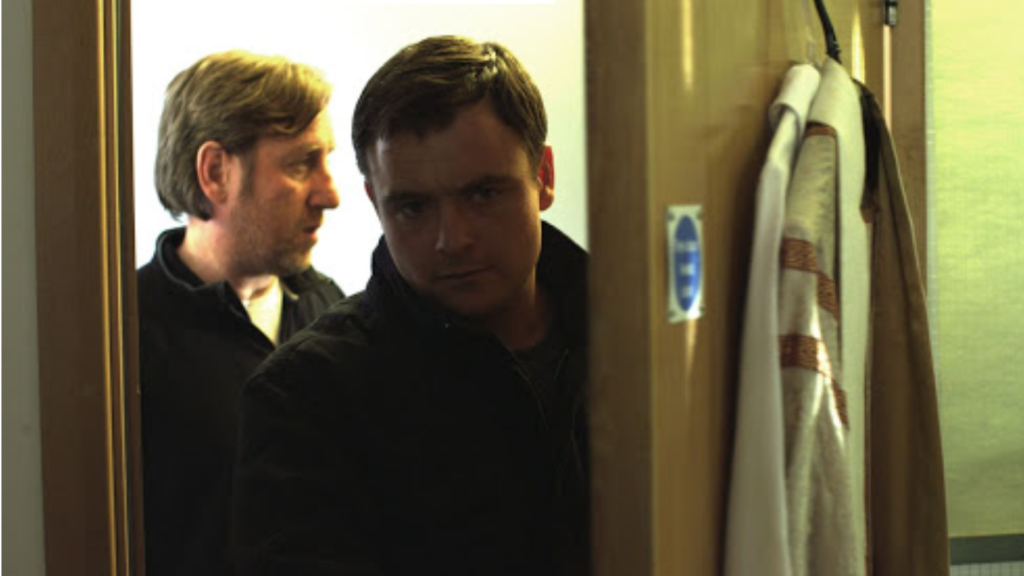
Kill List is directed and co-written by Ben Wheatley, a veteran British director who is no stranger to dark material. It starts with Jay (Neil Maskell) taking slack from his wife Shel (MyAnna Buring) because the money is running out and he hasn’t worked in eight months.
Jay and Shel have a seven-year-old son, but they are far from an ideal couple. For one thing, they bicker constantly. When their longtime friend Gal (Michael Smiley) arrives for a couples’ dinner with his girlfriend Fiona, one spat ends with Jay turning over his plate, food and all, and swiping the tablecloth off the table, dishes and all. Clearly, Jay has anger issues, and his marriage is at a breaking point. Fortunately, Gal has a job for him.
It turns out that Jay and Gal were both ex-military before becoming contract killers.
The next day, they go to meet their new employer, a creepy, wealthy elderly man who knows a little too much about Jay and Gal’s past, including what happened during their last job in Kyiv, a contract Jay apparently would rather forget. But regardless of the Kyiv incident, their new employer still wants to offer Jay and Gal a contract to assassinate three different men. When Jay agrees, he has his hand sliced open so he can sign the contract with his blood.
Kill List has a brutal realism to it that often makes it an uncomfortable watch. It starts with an abusive domestic situation, but that uncomfortable realism spills over into some graphically violent murders. Each name on the list gets its own chapter, with the middle chapter, “The Librarian,” being the most gruesome. I’m not going to say the violence in Kill List crosses into extreme territory, but it certainly moves close to that line. In fact, it’s not hard to find confessions from people online who claim they had to turn away from some scenes.
It helps that Maskell, Smiley, and Buring all act their asses off in this film. Wheatley had worked with Maskell and Smiley before, and the film was written specifically with all of its principal actors in mind, which helps explain how actors of this caliber willingly attached themselves to such a low-budget project. To give the characters a believable working-class authenticity, many of the lines were allowed to be improvised. The result is magic. Maskell in particular is perfect for his role. The longer he’s on screen, the more you genuinely believe this sombre husband and father truly is a ball of killing rage barely holding it all together. As a character, Jay should not be that complicated, but in Maskell’s hands, he feels nuanced and layered.
Smiley and Buring, for their part, do a great job playing off Maskell. Gal and Shel both try to manipulate Jay into moving in a certain direction, and their fights feel real, but so do their love and concern. These characters are not likable. There is a danger in all of them, but we empathise with them because they also seem like real people with a real history together, dealing with real problems in a real world. If they didn’t, the film wouldn’t work.
And Wheatley’s direction drops us right in the middle of their troubled lives. There is no hand-holding in this film. Information is rolled out slowly and organically, if it’s provided at all. And that’s the part of Kill List I now appreciate the most. We are mostly shown and rarely told. On occasion, what we are shown is left ambiguous, leaving us to make of it what we can. Sure, when we get to the end, we can better place some of the ambiguous scenes into the larger narrative, but many of the hows and whys are still left for us to fill in.
At 1 hour and 35 minutes, it’s also a film that keeps you feeling uneasy throughout most of its run-time.
For years I’ve seen Kill List pop up on lists of hidden horror gems. Its lasting legacy comes from its ambiguous, contradictory nature. It is a film grounded in brutal realism, yet its plot is fragmented and evasive. It is a film where it feels like every image, every line of dialogue uttered, has a hidden meaning, but we can’t always pinpoint why. Like a clever sleight of hand, the film feels like you can rewatch endlessly, yet never quite fully figure out its trick. It is a genuinely unique film experience.
I’ve read that Kill List got a 4K Blu-ray restoration in 2025, but honestly, I’m still happy rewatching it on my old DVD. When I see the film, I usually compare it to Polanski’s Rosemary’s Baby or The Ninth Gate, but the more common and obvious online film comparison is Robin Hardy’s 1973 masterpiece The Wicker Man. Like The Wicker Man, Kill List slowly reveals a sinister folk-horror undercurrent beneath an otherwise grounded story, but Wheatley risks leaving even more unanswered, giving the film plenty to chew on after the credits roll.
That’s high praise for a film that cost only $800,000.