Saccharine
2025
Rated: R
Genre: Drama, Horror
Country: Australia
Run-Time: 1h 52min
Director: Natalie Erika James
Cast
Midori Francis…………………….Hana
Danielle Macdonald………..Josie
Madeleine Madden…………Alanya
The Substance has revived interest in body horror. Not that the genre has ever gone away, but in the second half of the 2020s, it certainly now feels a bit more mainstream.
Perhaps the two most notable body horror entries that immediately followed The Substance‘s success are The Ugly Stepsister and Together. However, these films are different enough to avoid direct comparison. The Ugly Stepsister may share some thematic body-image elements with The Substance, but it’s the type of body horror that deals more with self-harm or mutilation (the kind I like best) instead of the more science-fiction type of body twisting. Together, on the other hand, does deal more with that latter type of body morphing, but thematically feels very different because of its focus on codependency.
However, two films, Grafted and Saccharine, are hard to discuss without acknowledging The Substance‘s long shadow, because they both centre on female protagonists whose use of pills or injections spirals into grotesque physical transformations. So they are often too easily dismissed as inferior copycats.
I get it. It’s a justified criticism. And it is true. Neither Grafted nor Saccharine reaches the over-the-top epic heights of The Substance. But having now watched all three, I can safely say that each of these films, all directed by women, distinguishes itself, if not thematically, then through its central premise. Yes, beauty standards are still front and centre, but how they get there is different enough. The Substance explores the divide between youth and aging. In contrast, Grafted is literally about wearing someone else’s skin, while Saccharine focuses more specifically on weight loss.
Of these three films, Saccharine is easily the scariest. That’s because it is more than just the story of a questionable concoction spiralling out of control after being overused. It is also a vengeful ghost story. For viewers expecting a simpler cautionary tale, though, how these two threads are juggled has made the film divisive.
But with three films to her credit, I have a pretty good understanding of how Australian director Natalie Erika James, best known for her debut film Relic, likes to operate, so the inclusion of a paranormal subplot should not come as a surprise. James enjoys using supernatural imagery as a metaphor for real psychological and social anxieties . In Relic, James uses a haunted house to deal with dementia. In Apartment 7A, the occult elements allow James to explore ideas of bodily autonomy, trauma and exploitation. With Saccharine, the ghost story directly ties into themes of body dysmorphia and disordered eating.
And of James’s three films, I think Saccharine is her strongest. It feels more assured in its pacing than the occasionally plodding slow burn of Relic, while showing greater confidence in balancing its supernatural and psychological elements than Apartment 7A. James has a remarkable eye for unsettling imagery, something even many of the negative viewer comments will acknowledge. So the horror elements alone make Saccharine worth a recommendation. And considering the general trend in 2026 toward putting storytelling ahead of scares, it’s good to see a film where some scares still have a place.
Saccharine follows an overweight medical student named Hana (Midori Francis), who has a chance encounter with Melissa, a girl she went to high school with. Hana assumes Melissa has apparently lost a lot of weight over the years, but Melissa points out that the weight loss is very recent, saying that it’s all because of an experimental diet drug she found online. Because Hana was one of the only people who was kind to Melissa in high school, Melissa offers her two of the diet pills to try, saying she’ll see results immediately.
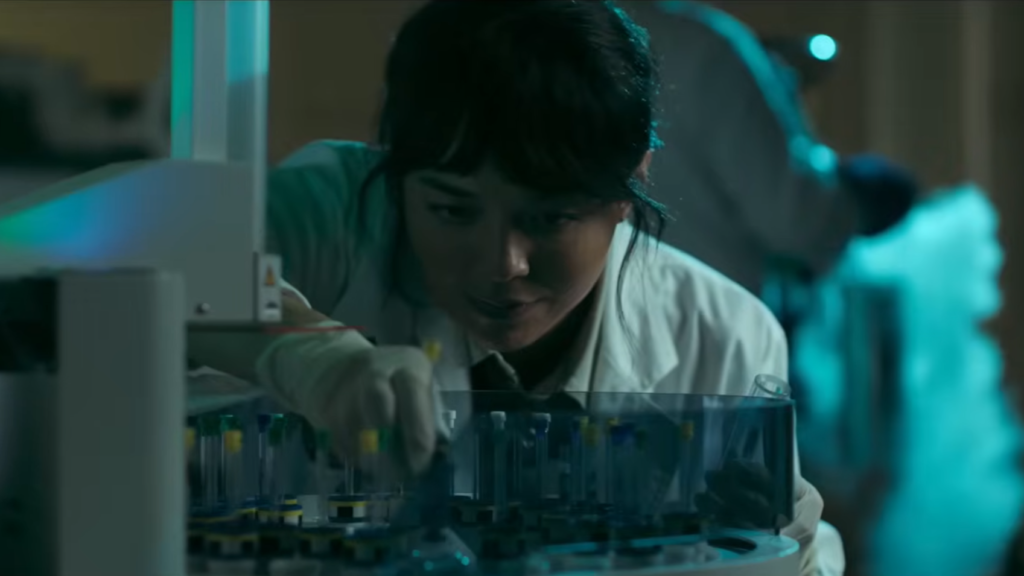
Hana takes one of the pills and, sure enough, she soon finds that she’s shed a few pounds despite a bad bout of binge eating. Impressed, Hana texts Melissa about how to acquire the pills, but the price is too high. So she runs tests on the remaining pill to see if she can reverse-engineer it. Turns out, the pill is mostly made up of human ash. Where is she going to get that?
Fortunately, Hana’s at the point in her training where she has started working with cadavers. Problem solved.
Obviously, Saccharine is going to invite comparisons to Ozempic and the current boom in weight-loss drugs. But James actually began writing the film in 2019, before Ozempic and similar drugs became the cultural phenomenon they are today. The connection is nevertheless hard to miss. People taking semaglutide drugs can experience side effects and serious complications, including severe gastrointestinal reactions, changes in vision and, in some cases, acute kidney injury.
Hana, too, is confronted with the question of whether the weight loss caused by her pills is worth the cost when she starts seeing her cadaver looming behind her in convex mirrors. Then she begins blacking out, only to wake up and find everything in her fridge eaten.
The cadaver itself, nicknamed Big Bertha by an insensitive colleague, serves as a reflection of how Hana sees herself. Bertha was a cancer patient with an eating disorder whom Hana believes is growing in size as she shrinks. This makes for some interesting body horror on two fronts. First, we see Hana losing weight to such a degree that she blows quickly past a healthy weight and descends into dangerously underweight territory. (There’s solid entertainment value in watching how the film handles the protagonist steadily shedding pounds.) Meanwhile, the ghostly antagonist gets gradually heavier and more threatening as the film continues. James has explained that this was deliberate: she wanted the ghost to represent the feeling of an eating disorder becoming an external force that takes control.
It is true that Saccharine does not have the best IMDb score: 5.9 as I’m writing this. Personally, I find some of the criticisms a bit silly.On one hand, you have viewers complaining about the film’s LGBTQ themes. There is another group that accuses James of fat-shaming. Well, Hana is a lesbian, and she does want to be fit and thin, and I can’t really tell people not to view movies through their political lens, because that statement too is political. But if either of these are deal-breakers, you probably aren’t enjoying the same movies as me.
However, there is a more reasonable criticism: Saccharine has a few too many ideas, and some have been left underdeveloped. For example, the subplot regarding her father (with a reveal that I saw coming) helped to explain some of Hana’s psychology, but I’ve read others who were either disappointed that the relationship was not developed further or wondered why it was included at all. The ending also takes a turn that comes a bit out of left field. In a story that is already juggling ghosts with eating disorders, perhaps the main narrative could have been kept tighter.
But here’s the thing: I didn’t mind any of these things. Everything works within the context of James’s horror metaphor. And some of the highest praise I’ve heard for the film seems to come from people who have dealt with real eating disorders, including one really intelligent writer who explained (spoiler coming) how well the ending depicts relapse. (A common problem with those who stop using GLP-1 drugs for weight management is that they may regain weight.)
I watched Saccharine the day after I saw Together, and truthfully, I enjoyed Saccharine a little bit more. Natalie Erika James is a master at using horror as a metaphor for psychological trauma and the things that can consume us, both literally and figuratively. Saccharine may be messier than Relic, but I found its combination of body horror, supernatural horror and psychological drama much more compelling. I know James’s film may not reach the outrageous heights of The Substance, but it doesn’t need to. Saccharine has enough unsettling imagery, disturbing ideas and genuine scares to stand on its own.